Tag: Strategy

  • Products and Processes

    Products and Processes

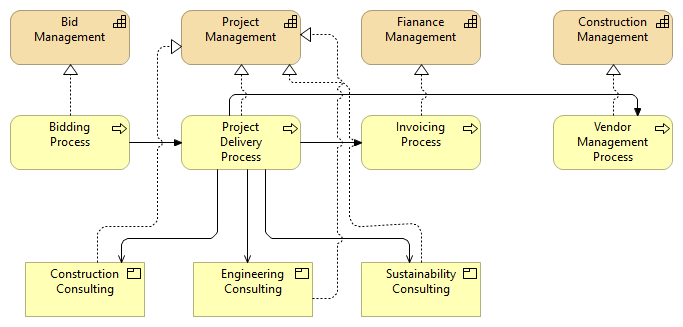
    The enterprise architect had the opportunity to interview some of the department heads of the AEC-company to learn more about how the core processes of the AEC-company supported deliveries of the products that the company sells currently and in the future as part of the realisation of the company strategy “Partnering for Green Construction”. While interviewing the head of departments the enterprise architect identifies that there are four key processes in scope for the company:

    • The bidding process. 
    • The project delivery process.
    • The invoicing process.
    • The vendor management process.

    While the enterprise architect modelled the relations among these high-level processes, then he began adding the relations among the processes and the capabilities and products, which is illustrated in the below illustration:
    During the interviews with the head of departments it became clear to the enterprise architect that the current processes also would have to be dealt with in order to enable the needed improvements of the capabilities of the AEC-company. The enterprise architect maps the assumed gaps among the core processes and the capabilities. This is illustrated in the illustration below:
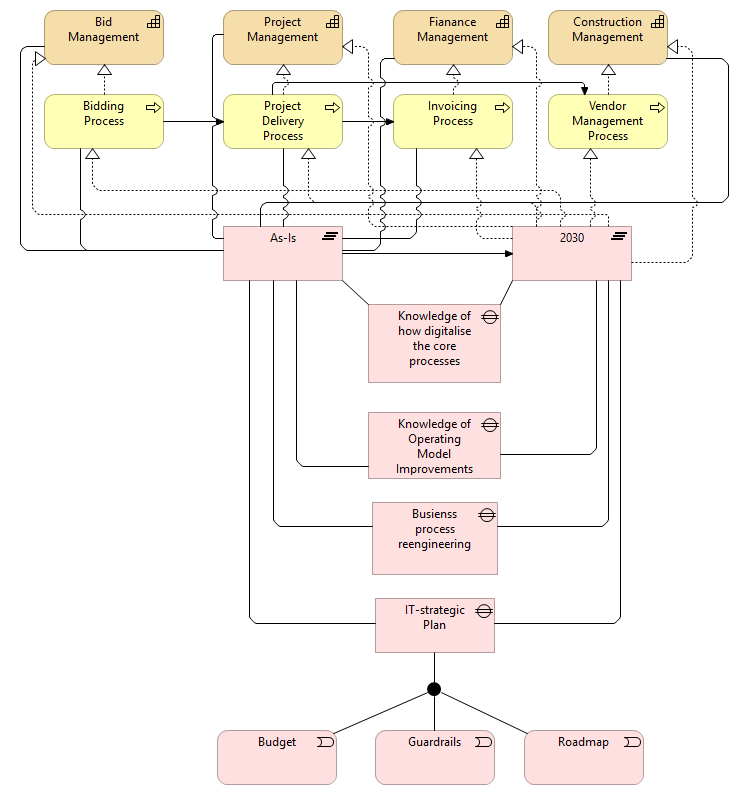
    You will see the four core processes have been mapped to four identified capabilities that they support the realization of. The four core processes and the four capabilities have relations to the “As-Is” plateau and all of them have realization relationships (pointing from) to the 2030 plateau. The enterprise architect is visualising that the core processes and capabilities exist today, but they will have to be enhanced as part of the “Partnering for Green Construction” business strategy, which is expected to be completed by the year 2030; and the enterprise architect identifies four major gaps to help enhancing the core processes and capabilities:

    • Knowledge of how to digitalise the core processes.
    • Knowledge of the operating model.
    • Business process reengineering.
    • IT-strategic plan.

    The enterprise architect already has an idea of what would be required before the IT-strategic plan is available to close the gaps:

    • Budget.
    • Guardrails.
    • Roadmap.

    The enterprise architect also realises that there are some knowledge gaps in the organisation that will have to be addressed as part of the implementation of the business strategy and essentially also the IT-strategy; and consequently a lot of clarifications will have to be conducted in order to get there.

    Line of Sight

    The enterprise architect can with his mappings among core (business) processes, capabilities and products see how these are impacting one another.

    The enterprise architect is now able to see how one of the core business processes is linked to two plateaus and must undergo changes:

  • Strategy, capabilities and products

    Strategy, capabilities and products

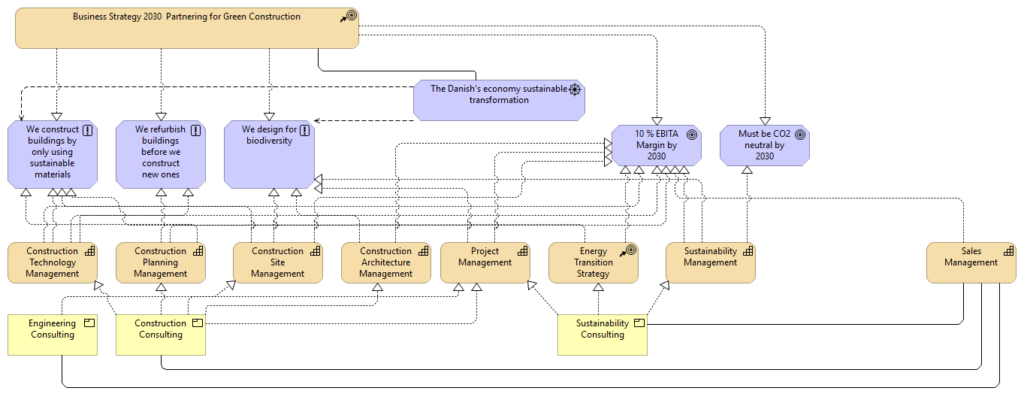
    The enterprise architect continued his work on sketching out the business strategy of the AEC-company. He decided to do so he could create a line of sight for the company’s CTO. The enterprise architect has begun mapping the business strategy to capabilities, principles, and the capabilities to products that are delivered by the AEC-company to its customers.

    The purpose of having such an overview as part of having an enterprise architecture programme (Please note an enterprise architecture endeavor is not a project) is to provide the overview relevant stakeholders on what the consequences of changes will be. Examples of this could be changes to the business strategy, changes to the business functions (Structure), products, and lastly how this will impact the business applications and digital infrastructure.

    The AEC-company provides three products for its customers:

    • Engineering consulting.
    • Construction consulting.
    • Sustainability consulting.

    Capabilities

    Since the AEC-company for historic reasons primarily sells the construction consulting products that are delivered as services, most of the capabilities owned by the AEC-company have been set up to support that specific product originally. 

    • Construction Site Management.
    • Construction Planning Management.
    • Construction Architecture Management.
    • Project Management.
    • Construction Technology Management (A recently created capability to support SMART-buildings and SMART-city trends).

    This also enforces a path dependency for the company, which means that adjustments and configurations will have to be done in order for the AEC-company to realise its business strategy. Construction of new buildings is one of the most CO2 emissions intensive activities that can take place, then the AEC-company will have to strengthen its existing capabilities and embed its existing practices from the sustainability management into the other capabilities as-well either as part of the business processes (Business practices).

    The path dependency will impact the AEC-company’s ability to adapt technologies minded for other types of consulting services to enhance its capabilities, its competitive position, competitive advantages or product line. Potentially this can become a risk for the AEC-company if its executive management does not understand the potential problems of not being able to navigate changes.

    The enterprise architect’s approach is to apply the top-down approach meaning that the line of sight must be based on the strategy elements (Course of action), drivers, goals, and products; which leads to the below illustration (Mapping):

    A Capabilities-Based Strategy

    The enterprise architect identifies that the AEC-company’s business strategy, Partnering for Green Construction, is reliant on a set of capabilities that provides strengths for the company and a set of capabilities that would need to be strengthened as part of the strategy period in order to ensure the completion of the strategy and its subsequent goals. One of many positive perspectives of approaching the business strategy from a capabilities-based perspective is that the capabilities can be used to identify areas that need improvements from four perspectives and each constitutes a value:

    • People with their skillsets.
    • Information technologies.
    • Data as in datasets and data products available.
    • Business processes and their states.

    The enterprise architect can with the above in mind use the capabilities to map the gap(s) and what would be needed to fill the gap(s); however applying the capabilities-based approach also enables the governance related deliverables needed to produce a system landscape that provides the business and IT-stakeholders the intended overview and possibility to ensure alignment across business demands and IT. This would also provide significant value for the AEC-company’s CTO in the discussions with the business stakeholders on how to enhance the capabilities of the AEC-company.


    The enterprise architect also realises by having this deliverable that enables the AEC-company to provide the foundational architectural services to support scenario planning and consequence planning; since there will be a trade off by each of the options that the executive management team will choose as part of the “Partnering for Green Construction”.

    The line of Sight

    The enterprise architect now has the ability to apply the level 3 depth of the relationships from the course of action element that represents the business strategy.

  • Business Strategy

    Business Strategy

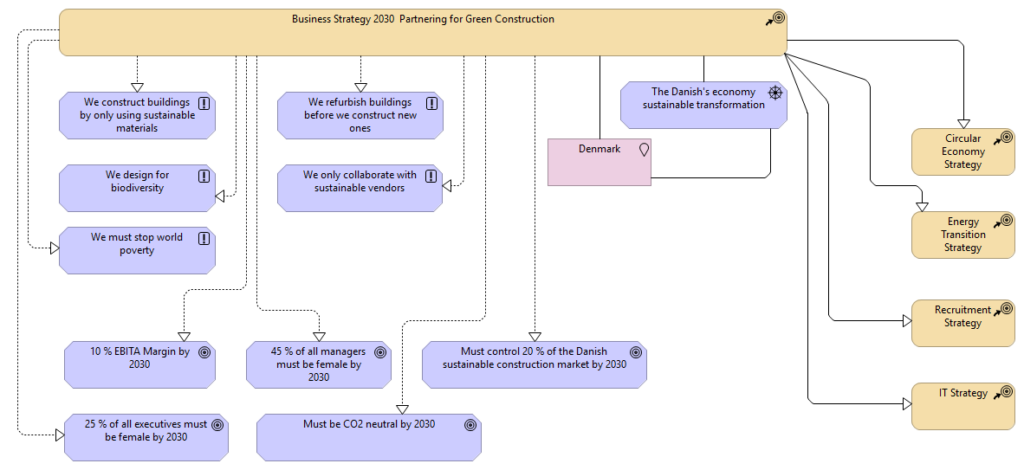
    The AEC-company has recently launched a new business strategy. The enterprise architect of the AEC-company has decided to map it out in order to create the relevant line of sight from the business strategy to other relevant perspectives.

    In the ArchiMate language (3.2) the strategy is symbolized through the use of a “call to action” object. The AEC-company’s executive management has identified a bold title and theme for the business strategy: “Partnering for Green Construction” and the business strategy must be fulfilled before 2030.

    On a side note:

    Even tough the title for the above business strategy seems unique, then I can assure it is not. Many big Danish AEC-companies have used titles such as:

    • The Partner for Sustainable Change (and subsequently closing the gaps).
    • Future Now.
    • Greensition.

    Partnering for Green Construction

    Components of the business strategy are mapped firstly:

    • Principles.
    • Drivers.
    • Objectives.
    • Function Strategies.

    The enterprise architect identifies five significant principles of the business strategy:

    • We construct buildings by only using sustainable materials.
    • We design for biodiversity.
    • We must stop world poverty.
    • We refurbish buildings.
    • We only collaborate with sustainable vendors.

    In addition to the principles the enterprise architect identifies five targets that must be achieved by 20230 as part of the business strategy:

    • 10 % EBITA margin by 2030.
    • 25 % of all executives must be female by 2030.
    • 45 % of all managers must be female by 2030.
    • The AEC-company must be CO2-neutral by 2030.

    The enterprise architect also identified a primary driver for the AEC-company to actually embark on the bold new business strategy: The Danish economy’s sustainable transformation.

    Lastly, the enterprise architect also identified that four function strategies have to be developed in order for the AEC-company to succeed:

    • Circular economy transition (Strategy).
    • Energy transition (Strategy).
    • Recruitment (Strategy).
    • IT strategy (Strategy).

    The Preliminary Line of Sight

    The enterprise architect can with the use of an enterprise architecture tool e.g., Archi be able to map out the relations among the different components and over time add further relations. Some tools like Archi also adds the possibility to group the dept-level of relations to and from the business strategy.