Tag: Line of Sight

  • The Exploration of the Project Delivery Process

    The Exploration of the Project Delivery Process

    The enterprise architect walked through the architecture documentation that he had produced together with the head of departments in the AEC-company, and he correctly identified the need for him to look into this important process as-well.

    For most Architecture, Engineering and Construction companies most of the services and products delivered are delivered through a rigorous project delivery process, since costs can increase significantly if the methodology and planning processes are not dealt with correctly.

    The project delivery process does in the context of the AEC-company handle everything from project methodology, capacity planning, allocation of resources, project planning, project execution and project documentation. The insights the enterprise architect has at this point in time are not thorough enough for producing the relevant planning for the digital transformation of the AEC-company. Consequently, the enterprise architect will have to conduct a similar clarification process for engaging with the subject matter experts with the current findings and then elaborating based on the data how the AS-IS state is and how the TO-BE state should be for the process:

    1. The first workshop is about getting answers for specific questions.
    2. The second workshop is about getting insights on the business applications and the dataflow.
    3. The third workshop is to present the TO-BE version of the process design including its usage of business applications.

    For the first workshop the enterprise architect desires to ask the below questions:

    • When making a planning a new project what applications do you make use of?
    • Who will you be contacting and how do you do so?
    • Where do you store the project planning, capacity requests, and customer data?
    • How do you create an overview of ongoing projects and capacity?

    The primary scope for the enterprise architect is to clarify the business applications (Application Components), the business interfaces and subsequent application interfaces needed in order for the business process to be designed to deliver on the goals that must be realized as part of the business strategy (Course of Action) “Partnering for Green Construction”.

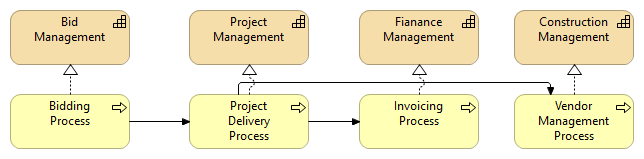
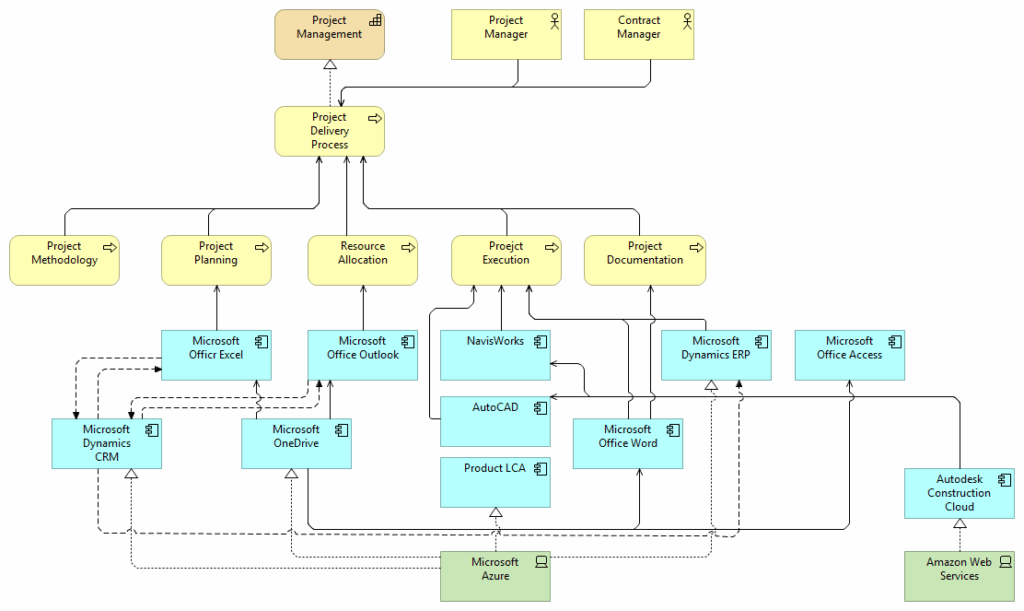
    The enterprise architect designs a high-level view of the “Project Delivery Process” for the TO-BE process beforehand, which makes the below view of the process a premature, and it will likely be updated after workshop 1 and 2:
    Line of Sight

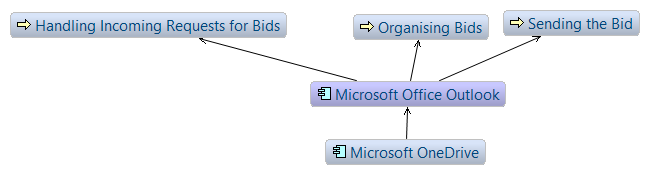
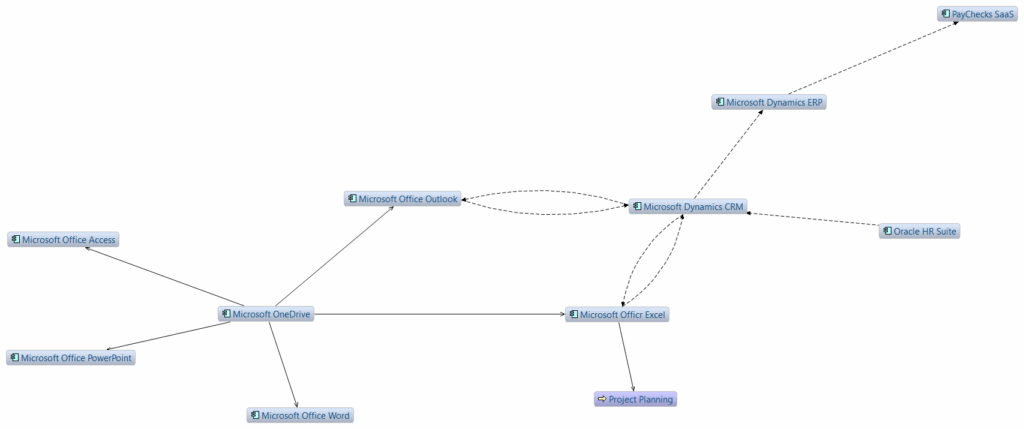
    After the enterprise architect has designed the above view of the TO-BE (Preliminary) process design for the project delivery process, then it is possible to interact with the below line of sight for the specific application components in the model. The below illustration is created by filtering on elements (Application Component) and filtering of viewpoint to “Application Structure”:

  • Transition Architecture

    Transition Architecture

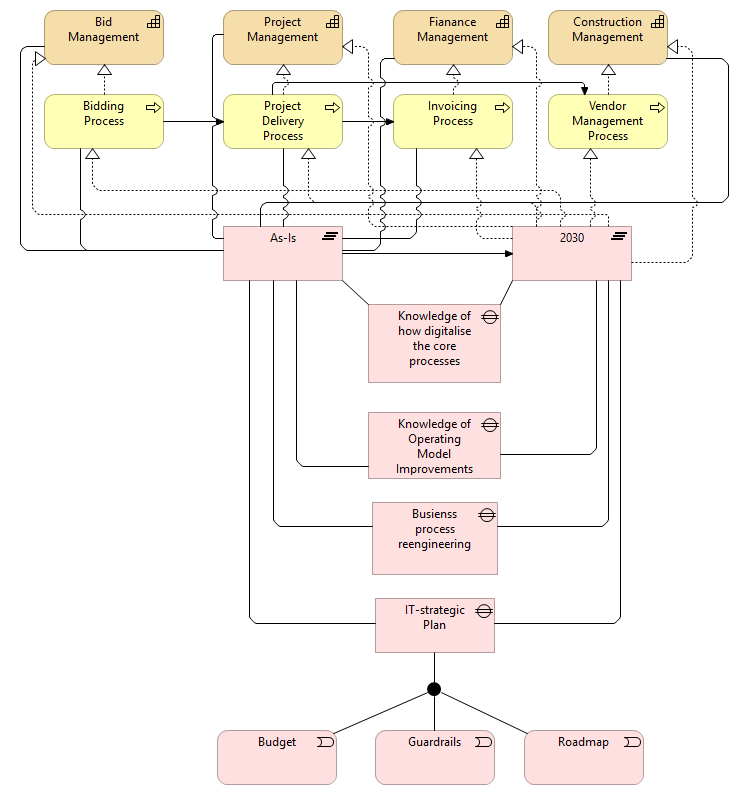
    The enterprise architecture of the AEC.company has now the overview of the as-is architecture of the AEC-company, and the enterprise architect revisits the high-level analysis that he conducted for the core business processes and the capabilities of the AEC-company, since this high-level analysis identified that the business strategy “Partnering for Green Construction” leaves some gaps that will have to be addressed by the enterprise architecture function and by the IT-department in the AEC-company in general:

    • The first gap is the lack of knowledge of how to digitalise the core processes in the AEC-company.
    • The second gap is the lack of knowledge of needed operating model improvements.
    • The third gap is the lack of knowledge of business process reengineering.
    • The fourth gap is the lack of an IT-strategic plan.

    These gaps will have to be dealt with in a coherent manner, since it would make no sense for the AEC-company to develop any deliverables of the IT-strategic plan without prior knowledge of how deliver better digitalisation of business processes, how to handle the operating model for the AEC-company in the 2030 plateau, where the business strategy “Partnering for Green Construction” will be delivered. The enterprise architect thought for a while and he realised that he would have to begin preparing workshops to capture the relevant information for the AEC-company to design the relevant architecture strategy and IT-strategy (Course of Action) for the AEC-company to succeed with the business strategy (Course of Action) known as “Partnering for Green Construction”.

    In order for the enterprise to assist the Chief Technology Officer and the IT-department filling the gaps, then he realises that he will have to call relevant stakeholders to a workshop. In this case he reuses the information he collected from the original interview of the heads of departments that he will have also to include the subject matter experts in the individual departments to gain the insights in the workshops. He decides to conduct three workshops for each of the core processes that earlier on have been identified as relevant to improve as part of the strategy, which also will improve the capabilities. The first workshop for each of the core business processes will be about the introduction of what is to be dealt with during the first workshop and the subsequent two workshops, and usually the first workshop is about identifying what is done today, and what is not working according to the subject matter experts. The second workshop will be about how the core business process looks like today and how it could be looking after it has been improved. The last workshop and final workshop for each of the core business processes will be like when implemented and what IT-systems will be when the core processes have been implemented.

    Since this approach is somewhat new for the stakeholders in the AEC-company, then the enterprise architect will have to come up with some suggestions up-front to inspire the subject matter experts during the workshops.

    The first process and subsequent capability that the enterprise architect starts with is the bidding process.

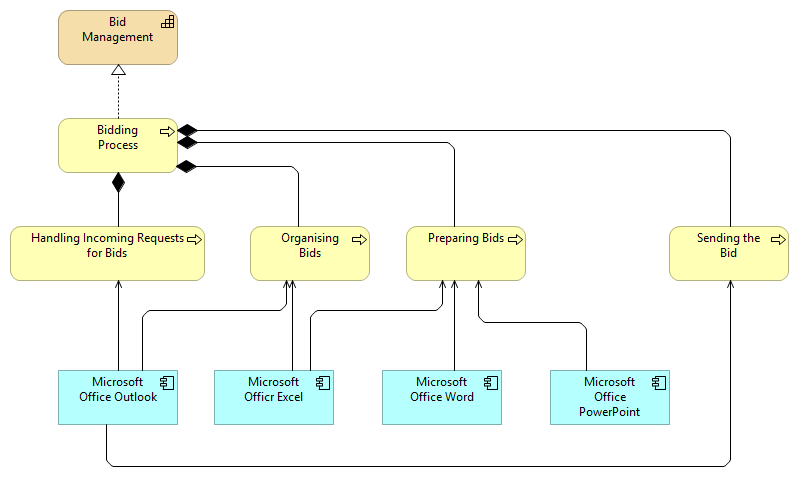
    The bidding process consists of a number of steps and it consists of a number of IT-systems that are used.

    The assumed most critical in these cases are the Office productivity suite since a lot of the communication and organisation of the bids takes place by initiating communication in the relevant departments and teams in the AEC-company.

    The enterprise architect realises that the primary application according to his preliminary analysis shows that Microsoft Office Outlook is to be considered a central business application in the as-is version of the core business process, and it is followed by Microsoft Office Word and Microsoft Office Excel for the internal use for calculating a bid. Lastly, if the AEC-company’s bid is accepted, then Microsoft Office Outlook and the different business applications from Autodesk comes into play in order to provide the relevant visuals for the different stakeholders at the customer side, when or if this is needed:

    The Line of Sight

    The enterprise architect now has the opportunity to look into what the bidding process consists of:

    In addition to this the enterprise architect has the opportunity to use both the business process view and the application view to see what the business process consists of and how it is served digitally as-is. In practice the top-down approach is preferred for strategic planning (course of actions) and the application view can be used for identifying tactical opportunities for business optimization through better use of technologies. This is what the two below diagrams are showing:

  • Applications and Infrastructure

    Applications and Infrastructure

    The enterprise architect identifies that there is yet another layer to map in order to gain the line of sight on how the strategy is impacted by the current digital infrastructure that the AEC-company makes use of; and the enterprise architect realises that the current mappings so far has focused mainly on the As-Is enterprise architecture of the AEC-company. Nonetheless, as the enterprise architect thought for himself, the journey has to start and end somewhere. The end is the To-Be architecture and in between is the transitional architecture(s). 

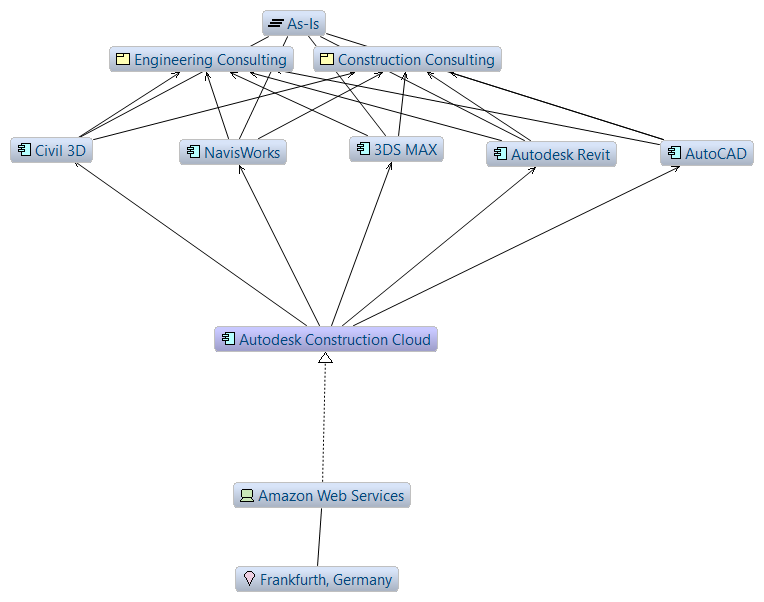
    With the As-Is enterprise architecture in mind the enterprise architect begins mapping the AEC-company’s application landscape and puts it to the infrastructure that has been chosen in the past.  The AEC-company makes use of the product suits from Autodesk to produce the construction consulting products, the engineering consulting products, and sustainability consulting products.

    While doing the mapping the enterprise architect begins mapping out the AEC-company’s core business usage e.g., the Microsoft Office productivity suite, the Microsoft based ERP-system, Microsoft Dynamics ERP that is used in combination with Microsoft Dynamics CRM, the HR-application suite and the salary management suite. The enterprise architect chooses to map the applications to the infrastructure that the vendors have informed the AEC-company that they are making use of, and in this case the enterprise architect chooses to map the cloud computing devices as devices and after doing so, the enterprise architect maps location to each of the infrastructure devices.

    Line of Sight

    The first illustration provides the enterprise architect with the view of relationships among the objects in the model that shows the As-Is architecture and that supports the engineering consulting product and the construction consulting products.

    The second illustration provides the enterprise architect with the insights into how the infrastructure (Technology layer) supports the sustainability product and the supporting processes of the AEC-company.

  • Strategy, capabilities and products

    Strategy, capabilities and products

    The enterprise architect continued his work on sketching out the business strategy of the AEC-company. He decided to do so he could create a line of sight for the company’s CTO. The enterprise architect has begun mapping the business strategy to capabilities, principles, and the capabilities to products that are delivered by the AEC-company to its customers.

    The purpose of having such an overview as part of having an enterprise architecture programme (Please note an enterprise architecture endeavor is not a project) is to provide the overview relevant stakeholders on what the consequences of changes will be. Examples of this could be changes to the business strategy, changes to the business functions (Structure), products, and lastly how this will impact the business applications and digital infrastructure.

    The AEC-company provides three products for its customers:

    • Engineering consulting.
    • Construction consulting.
    • Sustainability consulting.

    Capabilities

    Since the AEC-company for historic reasons primarily sells the construction consulting products that are delivered as services, most of the capabilities owned by the AEC-company have been set up to support that specific product originally. 

    • Construction Site Management.
    • Construction Planning Management.
    • Construction Architecture Management.
    • Project Management.
    • Construction Technology Management (A recently created capability to support SMART-buildings and SMART-city trends).

    This also enforces a path dependency for the company, which means that adjustments and configurations will have to be done in order for the AEC-company to realise its business strategy. Construction of new buildings is one of the most CO2 emissions intensive activities that can take place, then the AEC-company will have to strengthen its existing capabilities and embed its existing practices from the sustainability management into the other capabilities as-well either as part of the business processes (Business practices).

    The path dependency will impact the AEC-company’s ability to adapt technologies minded for other types of consulting services to enhance its capabilities, its competitive position, competitive advantages or product line. Potentially this can become a risk for the AEC-company if its executive management does not understand the potential problems of not being able to navigate changes.

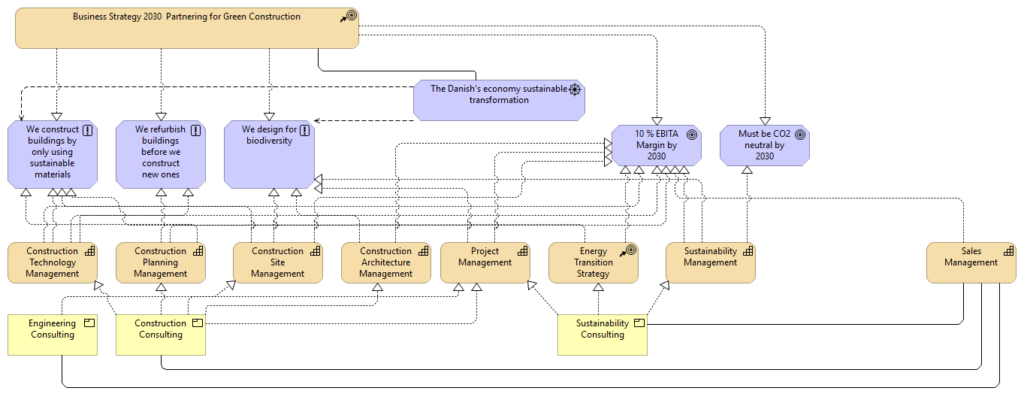
    The enterprise architect’s approach is to apply the top-down approach meaning that the line of sight must be based on the strategy elements (Course of action), drivers, goals, and products; which leads to the below illustration (Mapping):

    A Capabilities-Based Strategy

    The enterprise architect identifies that the AEC-company’s business strategy, Partnering for Green Construction, is reliant on a set of capabilities that provides strengths for the company and a set of capabilities that would need to be strengthened as part of the strategy period in order to ensure the completion of the strategy and its subsequent goals. One of many positive perspectives of approaching the business strategy from a capabilities-based perspective is that the capabilities can be used to identify areas that need improvements from four perspectives and each constitutes a value:

    • People with their skillsets.
    • Information technologies.
    • Data as in datasets and data products available.
    • Business processes and their states.

    The enterprise architect can with the above in mind use the capabilities to map the gap(s) and what would be needed to fill the gap(s); however applying the capabilities-based approach also enables the governance related deliverables needed to produce a system landscape that provides the business and IT-stakeholders the intended overview and possibility to ensure alignment across business demands and IT. This would also provide significant value for the AEC-company’s CTO in the discussions with the business stakeholders on how to enhance the capabilities of the AEC-company.


    The enterprise architect also realises by having this deliverable that enables the AEC-company to provide the foundational architectural services to support scenario planning and consequence planning; since there will be a trade off by each of the options that the executive management team will choose as part of the “Partnering for Green Construction”.

    The line of Sight

    The enterprise architect now has the ability to apply the level 3 depth of the relationships from the course of action element that represents the business strategy.