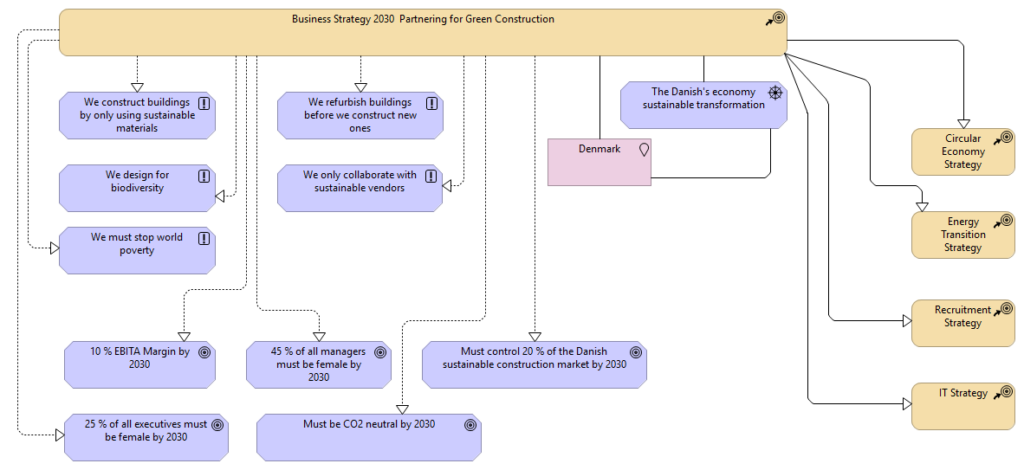
The enterprise architect had the opportunity to interview some of the department heads of the AEC-company to learn more about how the core processes of the AEC-company supported deliveries of the products that the company sells currently and in the future as part of the realisation of the company strategy “Partnering for Green Construction”. While interviewing the head of departments the enterprise architect identifies that there are four key processes in scope for the company:
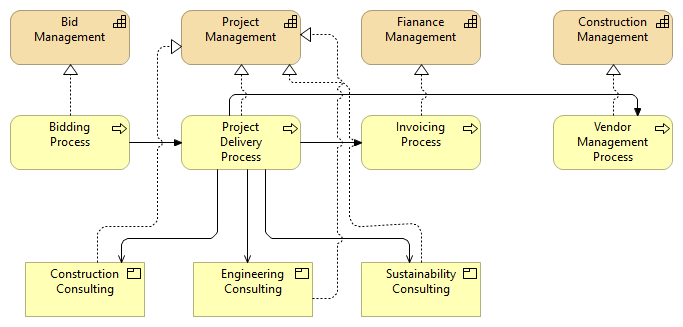
- The bidding process.
- The project delivery process.
- The invoicing process.
- The vendor management process.
While the enterprise architect modelled the relations among these high-level processes, then he began adding the relations among the processes and the capabilities and products, which is illustrated in the below illustration:
During the interviews with the head of departments it became clear to the enterprise architect that the current processes also would have to be dealt with in order to enable the needed improvements of the capabilities of the AEC-company. The enterprise architect maps the assumed gaps among the core processes and the capabilities. This is illustrated in the illustration below:
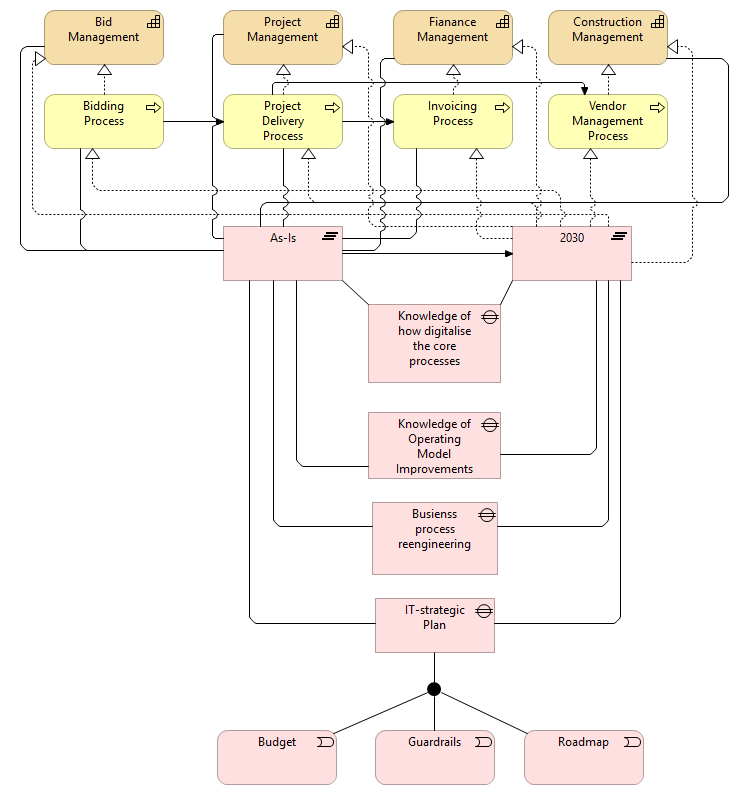
You will see the four core processes have been mapped to four identified capabilities that they support the realization of. The four core processes and the four capabilities have relations to the “As-Is” plateau and all of them have realization relationships (pointing from) to the 2030 plateau. The enterprise architect is visualising that the core processes and capabilities exist today, but they will have to be enhanced as part of the “Partnering for Green Construction” business strategy, which is expected to be completed by the year 2030; and the enterprise architect identifies four major gaps to help enhancing the core processes and capabilities:
- Knowledge of how to digitalise the core processes.
- Knowledge of the operating model.
- Business process reengineering.
- IT-strategic plan.
The enterprise architect already has an idea of what would be required before the IT-strategic plan is available to close the gaps:
- Budget.
- Guardrails.
- Roadmap.
The enterprise architect also realises that there are some knowledge gaps in the organisation that will have to be addressed as part of the implementation of the business strategy and essentially also the IT-strategy; and consequently a lot of clarifications will have to be conducted in order to get there.
Line of Sight
The enterprise architect can with his mappings among core (business) processes, capabilities and products see how these are impacting one another.

The enterprise architect is now able to see how one of the core business processes is linked to two plateaus and must undergo changes: